

How Many Parts Are In A Phone

Hardware-side view of a typical smartphone
The features of mobile phones are the ready of capabilities, services and applications that they offer to their users. Mobile phones are ofttimes referred to equally characteristic phones, and offer basic telephony.[ clarification needed ] Handsets with more advanced computing power through the employ of native code try to differentiate their own products past implementing additional functions to make them more attractive to consumers. This has led to great innovation in mobile phone evolution over the past 20 years.
The common components establish on all phones are:
- A number of metallic–oxide–semiconductor (MOS) integrated circuit (IC) chips.
- A battery (typically a lithium-ion battery), providing the power source for the phone functions.
- An input mechanism to allow the user to collaborate with the telephone. The most common input machinery is a keypad, simply touch screens are also found in smartphones.
- Basic mobile phone services to allow users to make calls and send text messages.
- All GSM phones use a SIM card to allow an account to be swapped among devices. Some CDMA devices likewise have a similar card called a R-UIM.
- Individual GSM, WCDMA, IDEN and some satellite phone devices are uniquely identified by an International Mobile Equipment Identity (IMEI) number.
All mobile phones are designed to work on cellular networks and contain a standard gear up of services that allow phones of different types and in dissimilar countries to communicate with each other. However, they tin can also back up other features added by diverse manufacturers over the years:
- roaming which permits the same telephone to be used in multiple countries, providing that the operators of both countries have a roaming agreement.
- send and receive data and faxes (if a computer is attached), access WAP services, and provide total Cyberspace access using technologies such as GPRS.
- applications similar a clock, alarm, calendar, contacts, and calculator and a few games.
- Sending and receiving pictures and videos (by without internet) through MMS, and for short distances with due east.g. Bluetooth.
- In Multimedia phones Bluetooth is commonly but important Characteristic.
- GPS receivers integrated or connected (i.due east. using Bluetooth) to cell phones, primarily to aid in dispatching emergency responders and road tow truck services. This feature is more often than not referred to as E911.
- Push to talk, available on some mobile phones, is a characteristic that allows the user to exist heard only while the talk push button is held, similar to a walkie-talkie.
- A hardware notification LED on some phones.
MOS integrated excursion chips [edit]
A typical smartphone contains a number of metal–oxide–semiconductor (MOS) integrated circuit (IC) fries,[1] which in turn contain billions of tiny MOS field-outcome transistors (MOSFETs).[2] A typical smartphone contains the post-obit MOS IC fries.[1]
- Application processor (CMOS arrangement-on-a-chip)
- Flash retentiveness (floating-gate MOS memory)
- Cellular modem (baseband RF CMOS)
- RF transceiver (RF CMOS)
- Phone photographic camera image sensor (CMOS epitome sensor)
- Power direction integrated circuit (power MOSFETs)
- Display driver (LCD or LED driver)
- Wireless advice chips (Wi-Fi, Bluetooth, GPS receiver)
- Audio chip (audio codec and power amplifier)
- Gyroscope
- Capacitive touchscreen controller (ASIC and DSP)[ane] [3] [4]
- RF power amplifier (LDMOS)[5] [vi] [vii]
User interface [edit]

Besides the number keypad and buttons for accepting and declining calls (typically from left to right and coloured green and carmine respectively), button mobile phones commonly feature two option keys, one to the left and one to the right, and a iv-directional D-pad which may feature a middle push button which acts in resemblance to an "Enter" and "OK" button.
A pushable gyre wheel has been implemented in the 1990s on the Nokia 7110.
Software, applications and services [edit]
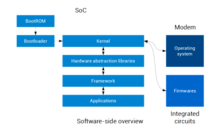
Software-side view of a typical smartphone
In early stages, every mobile phone company had its own user interface, which can exist considered as "closed" operating organisation, since there was a minimal configurability. A express variety of basic applications (usually games, accessories like calculator or conversion tool and and then on) was usually included with the phone and those were non available otherwise. Early mobile phones included bones web browser, for reading basic WAP pages. Handhelds (Personal digital administration like Palm, running Palm Os) were more sophisticated and also included more advanced browser and a affect screen (for use with stylus), just these were not broadly used, comparing to standard phones. Other capabilities similar Pulling and Pushing Emails or working with calendar were likewise made more attainable but information technology ordinarily required physical (and not wireless) Syncing. BlackBerry 850, an email pager, released January 19, 1999, was the start device to integrate Email.
A major step towards a more "open" mobile OS was the symbian S60 OS, that could be expanded past downloading software (written in C++, java or python), and its appearance was more than configurable. In July 2008, Apple tree introduced its App shop, which fabricated downloading mobile applications more accessible. In October 2008, the HTC Dream was the first commercially released device to utilize the Linux-based Android Os, which was purchased and further developed by Google and the Open Handset Alliance to create an open competitor to other major smartphone platforms of the time (Mainly Symbian operating organisation, BlackBerry OS, and iOS)-The operating organisation offered a customizable graphical user interface and a notification organisation showing a listing of recent letters pushed from apps.
The almost commonly used data application on mobile phones is SMS text messaging. The first SMS text message was sent from a computer to a mobile phone in 1992 in the U.k., while the first person-to-person SMS from phone to telephone was sent in Republic of finland in 1993.
The outset mobile news service, delivered via SMS, was launched in Finland in 2000. Mobile news services are expanding with many organizations providing "on-need" news services by SMS. Some also provide "instant" news pushed out by SMS.
Mobile payments were first trialled in Finland in 1998 when 2 Coca-Cola vending machines in Espoo were enabled to piece of work with SMS payments. Somewhen, the idea spread and in 1999 the Philippines launched the first commercial mobile payments systems, on the mobile operators Globe and Smart. Today, mobile payments ranging from mobile cyberbanking to mobile credit cards to mobile commerce are very widely used in Asia and Africa, and in selected European markets. Ordinarily, the SMS services apply brusque code.
Some network operators have utilized USSD for information, entertainment or finance services (east.g. Thou-Pesa).
Other non-SMS data services used on mobile phones include mobile music, downloadable logos and pictures, gaming, gambling, adult amusement and ad. The first downloadable mobile content was sold to a mobile phone in Finland in 1998, when Radiolinja (at present Elisa) introduced the downloadable ringtone service. In 1999, Japanese mobile operator NTT DoCoMo introduced its mobile Internet service, i-Fashion, which today is the world'due south largest mobile Internet service.
Even later on the appearance of smartphones, network operators take continued to offering data services, although in some places, those services accept become less mutual.
Power supply
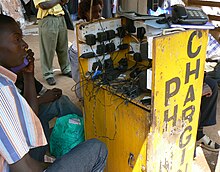
Mobile phone charging service in Republic of uganda

The world'south five largest handset makers introduced a new rating organisation in November 2008 to help consumers more hands identify the about energy-efficient chargers.[viii]
Mobile phones generally obtain ability from rechargeable batteries. There are a variety of ways used to accuse jail cell phones, including USB, portable batteries, mains power (using an AC adapter), cigarette lighters (using an adapter), or a dynamo. In 2009, the kickoff wireless charger was released for consumer apply.[9] Some manufacturers accept been experimenting with alternative power sources, including solar cells.[ten]
Various initiatives, such every bit the European union Common External Ability Supply have been appear to standardize the interface to the charger, and to promote free energy efficiency of mains-operated chargers. A star rating system is promoted by some manufacturers, where the most efficient chargers consume less than 0.03 watts and obtain a 5-star rating.
Battery [edit]
Nigh modern mobile phones use a lithium-ion bombardment.[11] [12] [13] A popular early mobile phone battery was the nickel metal-hydride (NiMH) blazon, due to its relatively small size and low weight. Lithium-ion batteries afterward became ordinarily used, as they are lighter and do not have the voltage depression due to long-term over-charging that nickel metal-hydride batteries practice. Many mobile phone manufacturers use lithium–polymer batteries as opposed to the older lithium-ion, the main advantages beingness even lower weight and the possibility to brand the battery a shape other than strict cuboid.[14]
SIM card [edit]
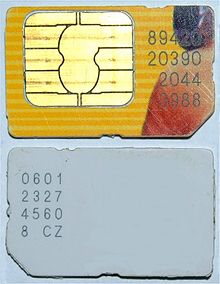
GSM mobile phones crave a minor microchip called a Subscriber Identity Module or SIM card, to function. The SIM card is approximately the size of a small postage stamp stamp and is commonly placed underneath the battery in the rear of the unit. The SIM securely stores the service-subscriber primal (IMSI) used to identify a subscriber on mobile telephony devices (such as mobile phones and computers). The SIM carte du jour allows users to change phones past merely removing the SIM card from one mobile telephone and inserting it into another mobile telephone or broadband telephony device.
A SIM card contains its unique serial number, internationally unique number of the mobile user (IMSI), security authentication and computation data, temporary information related to the local network, a list of the services the user has access to and ii passwords (PIN for usual use and PUK for unlocking).
SIM cards are bachelor in three standard sizes. The first is the size of a credit card (85.60 mm × 53.98 mm x 0.76 mm, defined by ISO/IEC 7810 every bit ID-i). The newer, most pop miniature version has the same thickness but a length of 25 mm and a width of 15 mm (ISO/IEC 7810 ID-000), and has 1 of its corners truncated (chamfered) to prevent misinsertion. The newest incarnation known as the 3FF or micro-SIM has dimensions of 15 mm × 12 mm. Well-nigh cards of the two smaller sizes are supplied every bit a full-sized bill of fare with the smaller card held in place past a few plastic links; information technology tin can easily be broken off to be used in a device that uses the smaller SIM.
The first SIM card was made in 1991 by Munich smart card maker Giesecke & Devrient for the Finnish wireless network operator Radiolinja. Giesecke & Devrient sold the first 300 SIM cards to Elisa (ex. Radiolinja).
Those cell phones that do non use a SIM menu accept the data programmed into their memory. This data is accessed by using a special digit sequence to access the "NAM" as in "Name" or number programming menu. From there, information can exist added, including a new number for the phone, new Service Provider numbers, new emergency numbers, new Authentication Key or A-Key code, and a Preferred Roaming List or PRL. However, to prevent the phone being accidentally disabled or removed from the network, the Service Provider typically locks this data with a Master Subsidiary Lock (MSL). The MSL also locks the device to a item carrier when it is sold every bit a loss leader.
The MSL applies only to the SIM, so in one case the contract has expired, the MSL still applies to the SIM. The telephone, yet, is also initially locked past the manufacturer into the Service Provider's MSL. This lock may be disabled so that the phone can apply other Service Providers' SIM cards. Nearly phones purchased outside the U.S. are unlocked phones considering in that location are numerous Service Providers that are close to ane another or have overlapping coverage. The cost to unlock a phone varies just is usually very inexpensive and is sometimes provided by contained telephone vendors.
A similar module called a Removable User Identity Module or RUIM card is present in some CDMA networks, notably in Communist china and Republic of indonesia.
Multi-card hybrid phones [edit]
A hybrid mobile phone can accept more than i SIM card, even of different types. The SIM and RUIM cards tin be mixed together, and some phones as well back up three or four SIMs.[xv] [16]
From 2010 onwards they became pop in India and Indonesia and other emerging markets,[17] attributed to the desire to obtain the lowest on-net calling rate. In Q3 2011, Nokia shipped xviii 1000000 of its depression cost dual SIM phone range in an attempt to make up lost ground in the higher terminate smartphone marketplace.[18]
Display [edit]
Mobile phones take a brandish device, some of which are also touch screens. The screen size varies greatly by model and is normally specified either as width and height in pixels or the diagonal measured in inches.
Some phones have more than 1 display, for instance the Kyocera Repeat, an Android smartphone with a dual 3.5 inch screen. The screens can also be combined into a single iv.vii inch tablet mode calculator.[nineteen]
Central processing unit [edit]
Mobile phones take central processing units (CPUs), like to those in computers, but optimised to operate in low power environments. In smartphones, the CPU is typically integrated in a arrangement-on-a-chip (SoC) application processor.
Mobile CPU functioning depends not only on the clock rate (generally given in multiples of hertz)[20] but as well the memory hierarchy also greatly affects overall performance. Because of these problems, the performance of mobile phone CPUs is frequently more appropriately given by scores derived from various standardized tests to measure the real effective performance in usually used applications.
Miscellaneous features [edit]
Other features that may be found on mobile phones include GPS navigation, music (MP3) and video (MP4) playback, RDS radio receiver, born projector, vibration and other "silent" ring options, alarms, memo recording, personal digital assistant functions, ability to lookout streaming video, video download, video calling, built-in cameras (i.0+ Mpx) and camcorders (video recording), with autofocus[ dubious ] and flash, ringtones, games, PTT, memory card reader (SD), USB (2.0), dual line support, infrared, Bluetooth (two.0) and WiFi connectivity, NFC, instant messaging, Cyberspace email and browsing and serving as a wireless modem.
The kickoff smartphone was the Nokia 9000 Communicator[ dubious ] in 1996 which added PDA functionality to the bones mobile telephone at the time. As miniaturization and increased processing power of microchips has enabled e'er more than features to be added to phones, the concept of the smartphone has evolved, and what was a high-terminate smartphone five years ago, is a standard phone today.
Several phone series accept been introduced to address a given marketplace segment, such every bit the RIM BlackBerry focusing on enterprise/corporate client electronic mail needs; the SonyEricsson Walkman series of musicphones and Cybershot series of cameraphones; the Nokia Nseries of multimedia phones, the Palm Pre the HTC Dream and the Apple tree iPhone.
Nokia and the University of Cambridge demonstrated a bendable cell telephone called the Morph.[21] Some phones have an electromechanical transducer on the back which changes the electric voice signal into mechanical vibrations. The vibrations flow through the cheek bones or forehead allowing the user to hear the conversation. This is useful in the noisy situations or if the user is difficult of hearing.[22]
As of 2018, there are smartphones that offer contrary wireless charging.[23]
Multi-mode and multi-ring mobile phones [edit]
Most mobile phone networks are digital and use the GSM, CDMA or iDEN standard which operate at various radio frequencies. These phones can only be used with a service program from the same visitor. For instance, a Verizon telephone cannot be used with a T-Mobile service, and vica versa.
A multi-mode telephone operates across different standards whereas a multi-band telephone (also known more than specifically as dual, tri or quad ring) mobile phone is a phone which is designed to work on more than one radio frequency. Some multi-way phones can operate on analog networks as well (for example, dual band, tri-mode: AMPS 800 / CDMA 800 / CDMA 1900).
For a GSM phone, dual-ring usually means 850 / 1900 MHz in the Us and Canada, 900 / 1800 MHz in Europe and virtually other countries. Tri-band means 850 / 1800 / 1900 MHz or 900 / 1800 / 1900 MHz. Quad-band ways 850 / 900 / 1800 / 1900 MHz, also called a world phone, since it can work on any GSM network.
Multi-band phones have been valuable to enable roaming whereas multi-fashion phones helped to innovate WCDMA features without customers having to surrender the wide coverage of GSM. Almost every single true 3G phone sold is actually a WCDMA/GSM dual-style mobile. This is also true of ii.75G phones such as those based on CDMA-2000 or EDGE.
Challenges in producing multi-way phones [edit]
The special challenge involved in producing a multi-mode mobile is in finding means to share the components between the different standards. Obviously, the phone keypad and display should be shared, otherwise it would be hard to treat as ane phone. Beyond that, though, there are challenges at each level of integration. How hard these challenges are depends on the differences between systems. When talking near IS-95/GSM multi-style phones, for example, or AMPS/IS-95 phones, the base band processing is very different from system to system. This leads to real difficulties in component integration and so to larger phones.
An interesting special case of multi-style phones is the WCDMA/GSM phone. The radio interfaces are very unlike from each other, only mobile to core network messaging has strong similarities, meaning that software sharing is quite easy. Probably more importantly, the WCDMA air interface has been designed with GSM compatibility in mind. It has a special way of performance, known equally punctured mode, in which, instead of transmitting continuously, the mobile is able to cease sending for a short period and try searching for GSM carriers in the area. This fashion allows for safety inter-frequency handovers with channel measurements which tin only be approximated using "airplane pilot signals" in other CDMA based systems.
A final interesting example is that of mobiles covering the DS-WCDMA and MC-CDMA 3G variants of the CDMA-2000 protocol. Initially, the bit rate of these phones was incompatible. Equally part of the negotiations related to patents, it was agreed to use compatible chip rates. This should mean that, despite the fact that the air and organisation interfaces are quite different, even on a philosophical level, much of the hardware for each organization inside a phone should exist common with differences existence more often than not bars to software.
Data communications [edit]
Mobile phones are now heavily used for data communications. such equally SMS messages, browsing mobile spider web sites, and even streaming sound and video files. The main limiting factors are the size of the screen, lack of a keyboard, processing power and connection speed. Most cellphones, which supports data communications, can be used every bit wireless modems (via cable or bluetooth), to connect computer to internet. Such access method is slow and expensive, just it can be available in very remote areas.
With newer smartphones, screen resolution and processing power has get bigger and better. Some new phone CPUs run at over i GHz. Many complex programs are at present available for the various smartphones, such as Symbian and Windows Mobile.
Connection speed is based on network back up. Originally data transfers over GSM networks were possible just over CSD (circuit switched data), information technology has bandwidth of 9600 fleck/s and usually is billed by connexion time (from network indicate of view, information technology does non differ much from voice phone call). Later on, there were introduced improved version of CSD - HSCSD (high speed CSD), it could use multiple time slots for downlink, improving speed. Maximum speed for HSCSD is ~42 kbit/s, information technology likewise is billed by time. Afterwards was introduced GPRS (full general packet radio service), which operates on completely different principle. Information technology also can employ multiple time slots for transfer, just it does not tie up radio resources, when not transferring information (as opposed to CSD and like). GPRS normally is prioritized under voice and CSD, so latencies are large and variable. Later, GPRS was upgraded to EDGE, which differs mainly by radio modulation, squeezing more data capacity in aforementioned radio bandwidth. GPRS and EDGE usually are billed by data traffic book. Some phones also feature full Qwerty keyboards, such as the LG enV.
Equally of Apr 2006, several models, such as the Nokia 6680, back up 3G communications. Such phones have access to the Web via a free download of the Opera web browser. Verizon Wireless models come with Internet Explorer pre-loaded onto the phone.
Vulnerability to viruses [edit]
As more than circuitous features are added to phones, they become more vulnerable to viruses which exploit weaknesses in these features. Even text letters can be used in attacks past worms and viruses.[24] Avant-garde phones capable of e-mail can exist susceptible to viruses that can multiply by sending letters through a phone'south address book.[ citation needed ] In some phone models, the USSD was exploited for inducing a factory reset,[25] resulting in immigration the data and resetting the user settings.
A virus may permit unauthorized users to admission a phone to detect passwords or corporate information stored on the device. Moreover, they can be used to commandeer the phone to make calls or send messages at the owner'southward expense.[ citation needed ]
Mobile phones used to have proprietary operating system unique only to the manufacturer which had the beneficial effect of making it harder to pattern a mass assault. However, the rise of software platforms and operating systems shared by many manufacturers such as Java, Microsoft operating systems, Linux, or Symbian Os, may increment the spread of viruses in the future.
Bluetooth is a feature at present found in many college-end phones, and the virus Caribe hijacked this office, making Bluetooth phones infect other Bluetooth phones running the Symbian OS. In early on November 2004, several web sites began offering a specific piece of software promising ringtones and screensavers for sure phones. Those who downloaded the software plant that it turned each icon on the telephone'due south screen into a skull-and-crossbones and disabled their phones, so they could no longer transport or receive text messages or access contact lists or calendars. The virus has since been dubbed "Skulls" past security experts. The Commwarrior-A virus was identified in March 2005, and it attempts to replicate itself through MMS to others on the phone'southward contact list. Like Cabir, Commwarrior-A also tries to communicate via Bluetooth wireless connections with other devices, which can somewhen atomic number 82 to draining the bombardment. The virus requires user intervention for propagation withal.
Bluetooth phones are also subject to bluejacking, which although non a virus, does permit for the transmission of unwanted messages from anonymous Bluetooth users.
Cameras [edit]
Most current phones also have a born digital photographic camera (see camera phone), that can take resolutions as loftier as 108M pixels. [26] This gives ascension to some concern nearly privacy, in view of possible voyeurism, for example in swimming pools. Due south Korea has ordered manufacturers to ensure that all new handsets emit a beep whenever a picture is taken.
Sound recording and video recording is ofttimes also possible. Virtually people do non walk around with a video camera, but do carry a phone. The inflow of video camera phones is transforming the availability of video to consumers, and helps fuel denizen journalism.
Run into also [edit]
- Mobile game
- Ringtone
- Smartphone
- Mobile phone form cistron
- Wallpaper
-
 Telephones portal
References [edit]
- ^ a b c Kim, Woonyun (2015). "CMOS power amplifier design for cellular applications: an EDGE/GSM dual-mode quad-band PA in 0.eighteen μm CMOS". In Wang, Hua; Sengupta, Kaushik (eds.). RF and mm-Wave Power Generation in Silicon. Academic Press. pp. 89–90. ISBN978-0-12-409522-nine.
- ^ "Remarks by Managing director Iancu at the 2019 International Intellectual Property Conference". United States Patent and Trademark Role. June 10, 2019. Archived from the original on 17 December 2019. Retrieved twenty July 2019.
- ^ Kent, Joel (May 2010). "Touchscreen technology basics & a new development". CMOS Emerging Technologies Conference. CMOS Emerging Technologies Research. 6: 1–13. ISBN9781927500057.
- ^ Ganapati, Priya (5 March 2010). "Finger Fail: Why Most Touchscreens Miss the Bespeak". Wired. Archived from the original on 11 May 2014. Retrieved 9 November 2019.
- ^ Baliga, Bantval Jayant (2005). Silicon RF Power MOSFETS. World Scientific. pp. 1–2. ISBN9789812561213.
- ^ Asif, Saad (2018). 5G Mobile Communications: Concepts and Technologies. CRC Press. p. 134. ISBN9780429881343.
- ^ "LDMOS Products and Solutions". NXP Semiconductors . Retrieved 4 December 2019.
- ^ Sheen, James (22 October 2009). "Meeting 30mW Standby in Mobile Telephone Chargers". Electronic Products. Archived from the original on 18 July 2010. Retrieved 4 Nov 2009.
- ^ goingcellular.com — Powermat wireless charger now bachelor
- ^ Charge Apply Mini Solar Panel | Android Phones.
- ^ Williams, R. K.; Darwish, G. N.; Blanchard, R. A.; Siemieniec, R.; Rutter, P.; Kawaguchi, Y. (2017). "The Trench Ability MOSFET—Part II: Application Specific VDMOS, LDMOS, Packaging, and Reliability". IEEE Transactions on Electron Devices. 64 (3): 692–712. doi:10.1109/TED.2017.2655149. ISSN 0018-9383. S2CID 38550249.
- ^ "IEEE Medal for Environmental and Safe Technologies Recipients". IEEE Medal for Environmental and Safety Technologies. Plant of Electric and Electronics Engineers. Retrieved 29 July 2019.
- ^ "Keywords to understanding Sony Free energy Devices – keyword 1991". Sony Energy Devices Corporation. Sony. Archived from the original on 4 March 2016. Retrieved seven December 2019.
- ^ "Jail cell Phone Battery Guide". Archived from the original on 11 June 2010. Retrieved sixteen June 2010.
- ^ Case of a Triple SIM hybrid phone.
- ^ The Latest F160 Quad Sim Quad Standby TV Java Phone with Qwerty Keyboard | Tri Sim Phones.
- ^ news.yahoo.com https://web.annal.org/web/20110508150638/http://news.yahoo.com/southward/nm/20110429/wr_nm/us_handsets. Archived from the original on May 8, 2011.
- ^ "Nokia boosted by sales of cheap handsets". October 20, 2011.
- ^ Kyocera Echo Phone Review | PCWorld.
- ^ "CPU Frequency". CPU World Glossary. CPU World. 25 March 2008. Retrieved 1 January 2010.
- ^ Reardon, Marguerite. "Nokia demos bendable jail cell phone". CNET News, February 25, 2008. Retrieved twenty July 2009.
- ^ Mito 228: Unique Handphone, Tin can Hear with the cheek Archived 2011-10-17 at the Wayback Motorcar, IeuMart.com
- ^ Sohail, Omar (October 16, 2018). "Huawei Takes a Jab at Apple tree - Says Its Mate twenty Pro Volition Be Able to Accuse iPhones Wirelessly".
- ^ "How Cell-phone Viruses Work". HowStuffWorks. 2005-10-04. Retrieved 2021-01-21 .
- ^ "'Dirty USSD' code could automatically wipe your Samsung TouchWiz device (updated)". Engadget.
- ^ "Oppo Reno 10x zoom - Full phone specifications". k.gsmarena.com.

How Many Parts Are In A Phone,
Source: https://en.wikipedia.org/wiki/Mobile_phone_features
Posted by: alexanderyescupon.blogspot.com
0 Response to "How Many Parts Are In A Phone"
Post a Comment