

Example Of Pyramid Of Number
Pyramid of Numbers - Environment Notes
A pyramid of numbers is one of the types of an ecological pyramid. The pyramid of numbers graphically depicts the population or affluence of an individual species involved at each level of a food concatenation. The pyramid of numbers depicts the number of organisms in each trophic level without taking into account their sizes or biomass. This commodity will explain to you lot well-nigh the Pyramid of Numbers which will exist helpful in preparing the Environment syllabus for the UPSC Civil service exam.
Concept
Pyramid of Numbers - Concept
- The total number of individuals (population) present at each trophic level is represented by a pyramid of numbers.
- Elton John popularized the term "pyramid of numbers" in 1972.
- When it comes to counting the number of creatures, this pyramid is actually efficient.
- Counting is a bones task that can be done over fourth dimension to determine how an ecosystem has changed. However, some creatures, peculiarly young forms, are hard to count.
- Depending on the number of organisms, the number pyramid is divided into two types: upright and inverted.
Types
Types of Pyramid of Numbers
Pyramid of Numbers - Upright
- In this pyramid, the number of individuals decreases equally they progress from the lowest to the highest trophic level.
- In the grassland and pond ecosystems, this sort of pyramid can be institute. Because of their affluence, grasses occupy the everyman trophic level (base).
- Primary consumers, such as grasshoppers, are the next college trophic level.
- The number of grasshoppers per square meter is fewer than that of grass.
- A bones carnivore, such as rats, is the side by side free energy level. Rats have a lower population than grasshoppers because they eat grasshoppers.
- Secondary carnivores, such as snakes, are the next higher trophic level. They eat rats.
- The top carnivore, such every bit Militarist, is the next higher trophic level. The number of individuals reduces as trophic levels ascension.

Pyramid of Numbers – Upright
Pyramid of Numbers - Inverted
- Inverted pyramids are the exact opposites of upright pyramids.
- In the tree ecosystem, where trees are the producers and insects are the consumers, this can be seen conspicuously.
- Nutrient wastage during eating, food wastage during digestion, and lastly nutrient utilization in the process of respiration and physical activities lead the population of college tropic individuals to steadily decline.
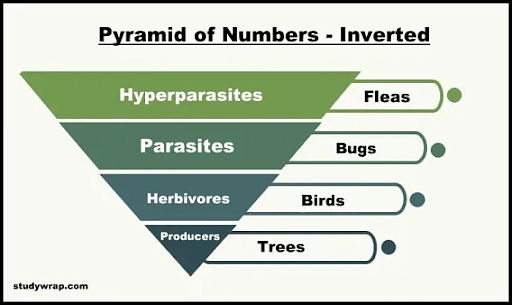
Inverted Pyramid of Numbers
Conclusion
Determination
Amidst the three pyramids of ecosystems, the number pyramid is the most erroneous because it does not account for the exact population. As a result, it is unable to fully describe the trophic structure of a system. The biomass of species is ignored in this pyramid, as is the energy transmitted between item groups. Number pyramids aren't particularly useful because they don't provide a clear or authentic image of the nutrient chain.
FAQs
FAQs
Question: What is a pyramid of numbers in ecology?
Answer:
A pyramid of numbers graphically depicts the population, or abundance, of individual species involved at each level of a food chain. This graph depicts the number of creatures in each trophic level without taking into account their sizes or biomass.
Question: Why is the pyramid of numbers inverted?
Reply:
In an ecosystem with a population that comprises a few large biomass suppliers who do good from a larger number of smaller consumers, an inverted pyramid of numbers tin exist seen.
Question: Which pyramid is always inverted?
Reply:
The population, biomass, and free energy of an ecosystem'due south progressive trophic levels are graphically represented in an ecological pyramid. In general, the biomass pyramid in the h2o is inverted.
MCQs
MCQs
Question: Consider the following statements on the Pyramid of Numbers
- In the upright pyramid of numbers, the number of individuals decreases as they progress from the lowest to the highest trophic level.
- This particular type is prevalent among grassland and swimming ecosystems.
Which of the statement(s) given above is/are correct?
(a) 1 only
(b) 2 only
(c) Both 1 and 2
(d) Neither 1 nor 2
Answer : (c) See the Explanation
- In the upright pyramid of numbers, the number of individuals decreases as they progress from the lowest to the highest trophic level.
- In the grassland and pond ecosystems, this sort of pyramid can be found. Because of their affluence, grasses occupy the lowest trophic level (base).
Therefore, option (c) is the correct answer.
Question: Which of the following types is prevalent in the tree ecosystem?
(a) Upright Pyramid of Numbers
(b) Inverted Pyramid of Numbers
(c) (a) and (b)
(d) None of the to a higher place
Answer: (b) See the Explanation
- Inverted pyramids are the exact opposites of upright pyramids.
- In the tree ecosystem, where trees are the producers and insects are the consumers, this can be seen clearly.
Therefore, selection (b) is the correct answer.
*The article might have information for the previous academic years, delight refer the official website of the exam.
How likely are y'all to recommend Prepp.in to a friend or a colleague?
Not and then likely
Highly likely
IAS (UPSC CSE) 2022-23 Mock Exam Serial
Drainage (Geography NCERT Class nine Chapter iii)
UPSC CSE 2022 Prelims PYQ: Economy (Part 3)
UPSC (CSE) Prelims Full Examination iv
UPSC (CSE) Prelims Full Exam 3
UPSC CSE 2022 Prelims PYQ: Economy (Part 1)
UPSC IAS PYP 2020 GS Newspaper one


Example Of Pyramid Of Number,
Source: https://prepp.in/news/e-492-pyramid-of-numbers-environment-notes
Posted by: alexanderyescupon.blogspot.com
0 Response to "Example Of Pyramid Of Number"
Post a Comment