

George Gray Edgar Lee Masters
| Edgar Lee Masters | |
|---|---|
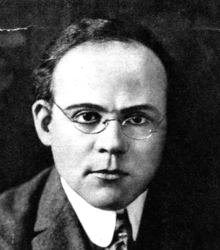 Masters as a young human being | |
| Built-in | (1868-08-23)Baronial 23, 1868 Garnett, Kansas, U.S.[1] |
| Died | March 5, 1950(1950-03-05) (aged 81) Melrose Park, Pennsylvania, U.Due south.[i] |
| Occupation |
|
| Notable awards | Robert Frost Medal (1942) |
Edgar Lee Masters (August 23, 1868 – March 5, 1950) was an American attorney, poet, biographer, and dramatist. He is the author of Spoon River Anthology, The New Star Bedchamber and Other Essays, Songs and Satires, The Smashing Valley, The Serpent in the Wilderness, An Obscure Tale, The Spleen, Marker Twain: A Portrait, Lincoln: The Homo, and Illinois Poems. In all, Masters published twelve plays, twenty-i books of poetry, half dozen novels and six biographies, including those of Abraham Lincoln, Mark Twain, Vachel Lindsay, and Walt Whitman.
Life and career [edit]
Born in Garnett, Kansas, to attorney Hardin Wallace Masters and Emma Jerusha Dexter,[ii] his father had briefly moved to set up upwardly a police practice, then soon moved dorsum to his paternal grandparents' farm near Petersburg in Menard County, Illinois. In 1880 they moved to Lewistown, Illinois, where he attended high school and had his offset publication in the Chicago Daily News. The culture around Lewistown, in addition to the town's cemetery at Oak Hill and the nearby Spoon River, were the inspirations for many of his works, nearly notably Spoon River Anthology, his most famous and acclaimed work.[iii]
He attended Knox Academy in 1889–90, a now defunct preparatory program run by Knox College, but was forced to exit due to his family unit's inability to finance his education.[ane]
Afterwards working in his male parent's law function, he was admitted to the Illinois bar and moved to Chicago, where he established a police force partnership in 1893 with the constabulary firm of Kickham Scanlan. He married twice. In 1898 he married Helen Yard. Jenkins, the daughter of Robert Edwin Jenkins, a lawyer in Chicago, and had three children. During his law partnership with Clarence Darrow from 1903 to 1908, Masters dedicated the poor. In 1911 he started his own law firm, despite three years of unrest (1908–11) caused by extramarital affairs and an argument with Darrow.[ citation needed ]
Two of his children followed him with literary careers. His daughter Marcia Masters pursued poetry, while his son Hilary Masters became a novelist. Hilary and his one-half-brother Hardin wrote a memoir of their father.[4]
Masters died in poverty at a nursing home on March 5, 1950, in Melrose Park, Pennsylvania, age 81.[5] He is cached in Oakland cemetery in Petersburg, Illinois. His epitaph includes his poem, "To-morrow is My Altogether" from Toward the Gulf (1918):
"Good friends, let's to the fields ...
Afterward a picayune walk, and past your pardon,
I call up I'll sleep. There is no sweeter thing,
Nor fate more blessed than to slumber.I am a dream out of a blessed sleep –
Permit's walk, and hear the distraction."
Family history [edit]
Edgar's male parent was Hardin Wallace Masters, whose male parent was Squire Davis Masters, whose begetter was Thomas Masters, whose father was Hillery Masters, the son of Robert Masters (born c. 1715, Prince George's County, Maryland, the son of William W. Masters and wife Mary Veatch Masters). Edgar Lee Masters wrote in his autobiography, Across Spoon River (1936), that his ancestor Hillery Masters was the son of "Knotteley" Masters, but family unit genealogies show that Hillery and Notley Masters were, in fact, brothers.[half dozen] [7]
Verse [edit]
Masters first published his early poems and essays under the pseudonym Dexter Wallace (later on his mother's maiden name and his male parent'southward heart name) until the twelvemonth 1903, when he joined the law firm of Clarence Darrow. Masters began developing as a notable American poet in 1914, when he began a series of poems (this time under the pseudonym Webster Ford) near his childhood experiences in Western Illinois, which appeared in Reedy'south Mirror, a St. Louis publication.
In 1915 the series was bound into a volume and re-titled Spoon River Album. Years later, he wrote a memorable and invaluable account of the volume's background and genesis, his working methods and influences, as well as its reception by the critics, favorable and hostile, in an autobiographical article notable for its human warmth and general interest.[8]
Although he never matched the success of his Spoon River Anthology, he did publish several other volumes of poems including Book of Verses in 1898, Songs and Sonnets in 1910, The Nifty Valley in 1916, Song and Satires in 1916, The Open Sea in 1921, The New Spoon River in 1924, Lee in 1926, Jack Kelso in 1928, Lichee Nuts in 1930, Gettysburg, Manila, Acoma in 1930, Godbey, sequel to Jack Kelso in 1931, The Snake in the Wilderness in 1933, Richmond in 1934, Invisible Landscapes in 1935, The Golden Fleece of California in 1936, Poems of People in 1936, The New Globe in 1937, and More People in 1939.[ citation needed ] Two of his later volumes were published by the Decker Press after its founder, James Decker, asked Masters for permission to print his work; Masters agreed and Illinois Poems was published in 1941 and Along the Illinois was released in 1942.[9]
Notable works [edit]
Verse [edit]
- A Book of Verses (1898)
- Songs and Sonnets (1910)
- Spoon River Anthology (1915)
- Songs and Satires (1916)
- Fiddler Jones (1916)
- The Great Valley (New York: Macmillan Co., 1916)
- Toward the Gulf (New York: Macmillan Co., 1918)
- Starved Rock (New York: Macmillan Co., 1919)
- Jack Kelso: A Dramatic Poem (1920)
- Domesday Volume (New York: Macmillan Co., 1920)
- The Open Bounding main (New York: Macmillan Co., 1921)
- The New Spoon River (New York: Macmillan Co., 1924)
- Selected Poems (1925)
- Lichee-Nut Poems (American Mercury, Jan. 1925)
- Lee: A Dramatic Poem (1926)
- Godbey: A Dramatic Verse form (1931), sequel to Jack Kelso (1920)
- The Serpent in the Wilderness (1933)
- Richmond: A Dramatic Verse form (1934)
- Invisible Landscapes (1935)
- Poems of People (1936)
- The Gold Fleece of California (1936) (poetic narrative)
- The New Earth (1937)
- More People (1939)
- Illinois Poems (1941)
- Along the Illinois (1942)
- Silence (1946)
- George Grayness
- Many Soldiers
- The Unknown
Biographies [edit]
- Children of the Marketplace Place: A Fictitious Autobiography (New York: Macmillan Co., 1922). Life of Stephen Douglas.
- Levy Mayer and the New Industrial Era (New Haven: Yale University Printing, 1927).[10] Chicago chaser Levy Mayer (1858–1922).
- Lincoln: The Man (1931)
- Vachel Lindsay: A Poet in America (1935)
- Across Spoon River: An Autobiography (memoir) (1936)
- Whitman (1937)
- Marking Twain: A Portrait (1938)
Books [edit]
- Maxmilian: A Drama (1902)
- The New Star Bedchamber and Other Essays (1904)
- The Blood of the Prophets (1905) (play)
- Althea (1907) (play)
- The Trifler (1908) (play)
- Mitch Miller (novel) (1920)
- Skeeters Kirby (novel) (1923)
- The Nuptial Flight (novel) (1923)
- Kit O'Brien (novel) (1927)
- The Fate of the Jury: An Epilogue to Domesday Book (1929)
- Gettysburg, Manila, Acoma: Three Plays (1930)
- The Tale of Chicago (1933)
- The Tide of Time (novel) (1937)
- The Sangamon (Chicago: University of Illinois Press, 1942, 1988)
Awards and honors [edit]

Postal stamp, issued Baronial 22, 1970
Masters was awarded the Mark Twain Silver Medal in 1936, the Poetry Society of America medal in 1941, the University of American Poets Fellowship in 1942, and the Shelly Memorial Award in 1944. In 2014, he was inducted into the Chicago Literary Hall of Fame.[11]
References [edit]
- ^ a b c "Edgar Lee Masters profile, ibid". Poets.org. Retrieved September 10, 2013.
- ^ Profile, illinois.edu. Retrieved Dec thirteen, 2015.
- ^ Profile, bartleby.com. Retrieved Dec thirteen, 2015.
- ^ "Jack Masters contour". Jackmasters.net. Retrieved September 10, 2013.
- ^ Ehrlich, Eugene and Gorton Carruth. The Oxford Illustrated Literary Guide to the United States. New York: Oxford Academy Press, 1982: p. 206; ISBN 0-19-503186-v
- ^ The Masters Family unit [ permanent dead link ] , findagrave.com. Retrieved December xiii, 2015.
- ^ Charles Burgess, "The Maryland-Carolina Ancestry of Edgar Lee Masters", The Bully Lakes Review, vol. 8, No. ii (Autumn 1982-Jump 1983), pp. 51–eighty.
- ^ Edgar Lee Masters, "The Genesis of Spoon River", American Mercury, v. 28, no. 109 (Jan 1933), pp. 38–55.
- ^ Hallwas, John (1983). "Verse and Murder: Prairie City's Decker Press". Western Illinois Heritage. Illinois Heritage Press. pp. 187–189. ISBN978-9994715442.
- ^ "Edgar Lee Masters (1869–1950) Papers, ca. 1927". Findingaids.library.northwestern.edu . Retrieved October 17, 2016.
- ^ Chicago Literary Hall of Fame website. Retrieved October viii, 2017.
External links [edit]
- Edgar Lee Masters Papers at the Harry Ransom Center
- Works by Edgar Lee Masters in eBook grade at Standard Ebooks
- Edgar Lee Masters at the Modern American Poesy Site of the University of Illinois at Urbana–Champaign
- Works by Edgar Lee Masters at Projection Gutenberg
- Works past or about Edgar Lee Masters at Internet Archive
- Works by Edgar Lee Masters at LibriVox (public domain audiobooks)

- Books by Edgar Lee Masters in PDF at Penn State's Electronic Classics Series site
- A large collection of Edgar Lee Masters' papers is held at the Harry Ransom Humanities Inquiry Center at The Academy of Texas at Austin
- Complete text of Spoon River Anthology
- Spoon River Anthology online edition with cross-references and comments
- Agnes Lee – Edgar Lee Masters Papers Archived Jan 6, 2015, at the Wayback Machine at Newberry Library
- Dorothy Dow papers, including correspondence with Edgar Lee Masters Archived January 6, 2015, at the Wayback Auto at Newberry Library
- Finding assist to Edgar Lee Masters papers, 1910-1942, at Columbia University. Rare Book & Manuscript Library.

George Gray Edgar Lee Masters,
Source: https://en.wikipedia.org/wiki/Edgar_Lee_Masters
Posted by: alexanderyescupon.blogspot.com
0 Response to "George Gray Edgar Lee Masters"
Post a Comment